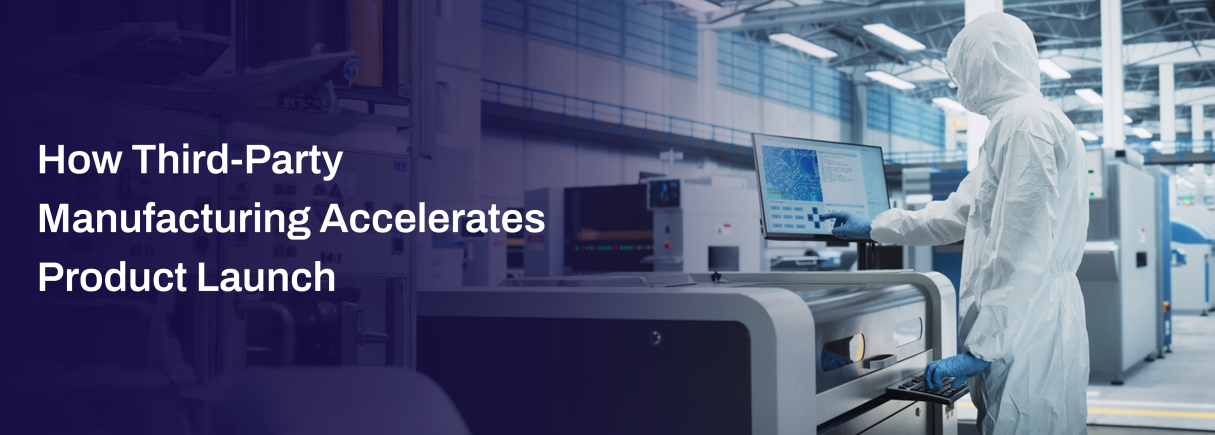
How Third-Party Manufacturing Accelerates Product Launch
Speed is not merely an asset in the contemporary business environment; it is a survival characteristic. We live in an era where a viral trend can create massive consumer demand overnight, and a delay of even a few months can mean the difference between leading a market and chasing the heels of a competitor. To numerous entrepreneurs, as well as established businesses, the greatest bottleneck is not the idea; it is the execution.
The process of developing a product is a very thrilling process that consists of a series of ups and downs, the valley of death, that is usually between the prototype and the store shelf. The old-fashioned method of constructing your own factory, employing a labor force, and obtaining each screw and sensor one by one is a slow process that is capital-intensive.
This is where third-party manufacturing (or contract manufacturing) comes in. When you collaborate with a well-established producer, you are not outsourcing labor; you are pouring high-octane fuel into your supply chain.
Bypassing the Infrastructure Barrier
Instant Access to Advanced Machinery
The use of specialized tools is needed in specialized products. It may be the purchase and calibration of high-precision CNC machines, a clean-room setting to handle electronic parts, or industrial-grade mixing vats to deal with cosmetics, the lead time to buy and calibrate such equipment can take 6-12 months.
When you partner with a third-party manufacturer, that machinery is already warm and running. You skip the procurement, the shipping delays, and the technical "teething" phase of new equipment, moving your project to the front of the line immediately.
Ready-Made Regulatory Compliance
Navigating the legalities of manufacturing is a bureaucratic marathon. Obtaining certifications like ISO 9001 for quality management, FDA approvals for consumables, or GMP (Good Manufacturing Practices) for pharmaceuticals can take years of audits and structural adjustments. Third-party manufacturing pharma thrive on these certifications; it is their "license to operate." By utilizing their facilities, your product inherits the safety and legal standards already in place, saving you from the grueling process of starting a compliance department from zero.
Scalability Without Construction
What happens if your product launch is too successful? If you own a small workshop and demand triples overnight, you face the nightmare of a 12-month construction project to expand your floor space. However, a PCD pharma franchise in India usually operates at a scale that allows for rapid expansion. They can often shift shifts or allocate more lines to your product in a matter of weeks, allowing you to ride the wave of a successful launch without the "out of stock" notifications that kill brand momentum.
Tapping Into an Established Knowledge Base
Rapid Prototyping and DFM (Design for Manufacturing)
There is a big difference between a prototype that works on a desk and a product that can be mass-produced efficiently. This is known as Design for Manufacturing (DFM). Seasoned manufacturers are free to examine your schematics and point out areas of pain, such as where a screw might be, which slows assembly, or a material selection that is likely to warp. By uncovering these problems at the prototyping stage, they avoid the back-to-the-drawing-board calamities that plague individual inventors.
Skilled Labor on Demand
Finding, vetting, and training a specialized workforce is one of the most underrated delays in business. When your product needs a complex soldering process or a delicate hand-stitching process, you cannot just go to the street and employ anybody. A contract manufacturer provides a pre-trained, highly skilled workforce. You don't have to worry about HR, payroll, or training cycles; you simply leverage their human capital to get your product assembled by experts from day one.
Shortening the Procurement Cycle
Existing Vendor Relationships
When you enter the market as a new brand, you are at the bottom of the priority list for raw material suppliers. Third-party manufacturers are "preferred buyers." They have spent decades building relationships with vendors and buying in massive volumes. This implies that with a lack of materials, your manufacturer can command the, so to speak, clout to get your parts in promptly, where a smaller, single operation may be waiting several months.
This 'clout' ensures that whether you are sourcing rare chemicals or a complete Cardiac & Diabetic Product List for Pharma Franchise Business, your supply chain remains uninterrupted during global shortages.
Bulk Purchasing Power
The price of materials is usually dependent on the size of the order. Although you may start small in your first launch, your manufacturer is probably purchasing the same raw materials for a number of customers. This aggregated demand enables them to buy materials at a reduced cost, and more importantly, they have a continuous supply of stock. This is a strong financial and logistic advantage to remain on time in the course of international supply-chain changes.
Logistics and Distribution Integration
The journey doesn't end when the product is boxed. Many modern third-party manufacturers offer "turnkey" solutions, including warehousing and "pick and pack" services. By integrating production with logistics, you eliminate the time spent shipping goods from a factory to a separate distribution center. Your product can go straight from the assembly line to a courier, shaving days or even weeks off the total time it takes to reach your customer's doorstep.
Financial Agility and Risk Mitigation
When evaluating your entry strategy, understanding the pharma franchise cost in India can help you allocate more budget toward aggressive marketing and customer acquisition.
Reducing Upfront Capital Expenditure (CapEx)
Building a factory requires millions of dollars in upfront investment. That is money that is "locked" in brick and mortar. By outsourcing production, you convert those massive fixed costs into variable costs. Instead of paying for a building and machines, you pay per unit produced. This frees up your capital to be spent where it matters most during a launch: marketing, branding, and customer acquisition.
Faster Iteration Cycles
In today’s market, the "Version 1.0" of a product is rarely the final one. You might find that customers want a different color, a smaller size, or a modified feature. If you own the factory, retooling your machines for a change can be a logistical nightmare. A third-party manufacturer is built for flexibility. They are able to switch production lines far more quickly, so you get a chance to test small beta production batches on the market, get a response and release a Version 2.0 before your competitors have even finished the first run.
Mitigating Market Volatility
What if the market changes? What if a new technology renders your current design obsolete? If you own the infrastructure, you are "married" to your current setup. If you use third-party manufacturing pharma, you have the agility to shift. You aren't stuck with a specialized machine that no longer serves a purpose. This "asset-light" model is the secret weapon of the world’s most successful tech and consumer goods companies, allowing them to remain nimble in an unpredictable economy.
Conclusion
It is no longer simply a means to save money, third-party manufacturing is a strategic way to buy time in the race to market. With the help of available infrastructure, expert knowledge, and proven supply chains, you can take years of development and condense it into months of implementation.
A PCD pharma franchise in India is not simply a vendor but it is a growth engine. They enable you to concentrate on what you are good at, innovation, and rapport with your audience as they do the hard work of physical creation. When you need to bring your vision to life at a rate that is both fast and accurate, the right third party partner could be the most significant addition to your team that will ever happen. Would you be willing to speed up your launch?